
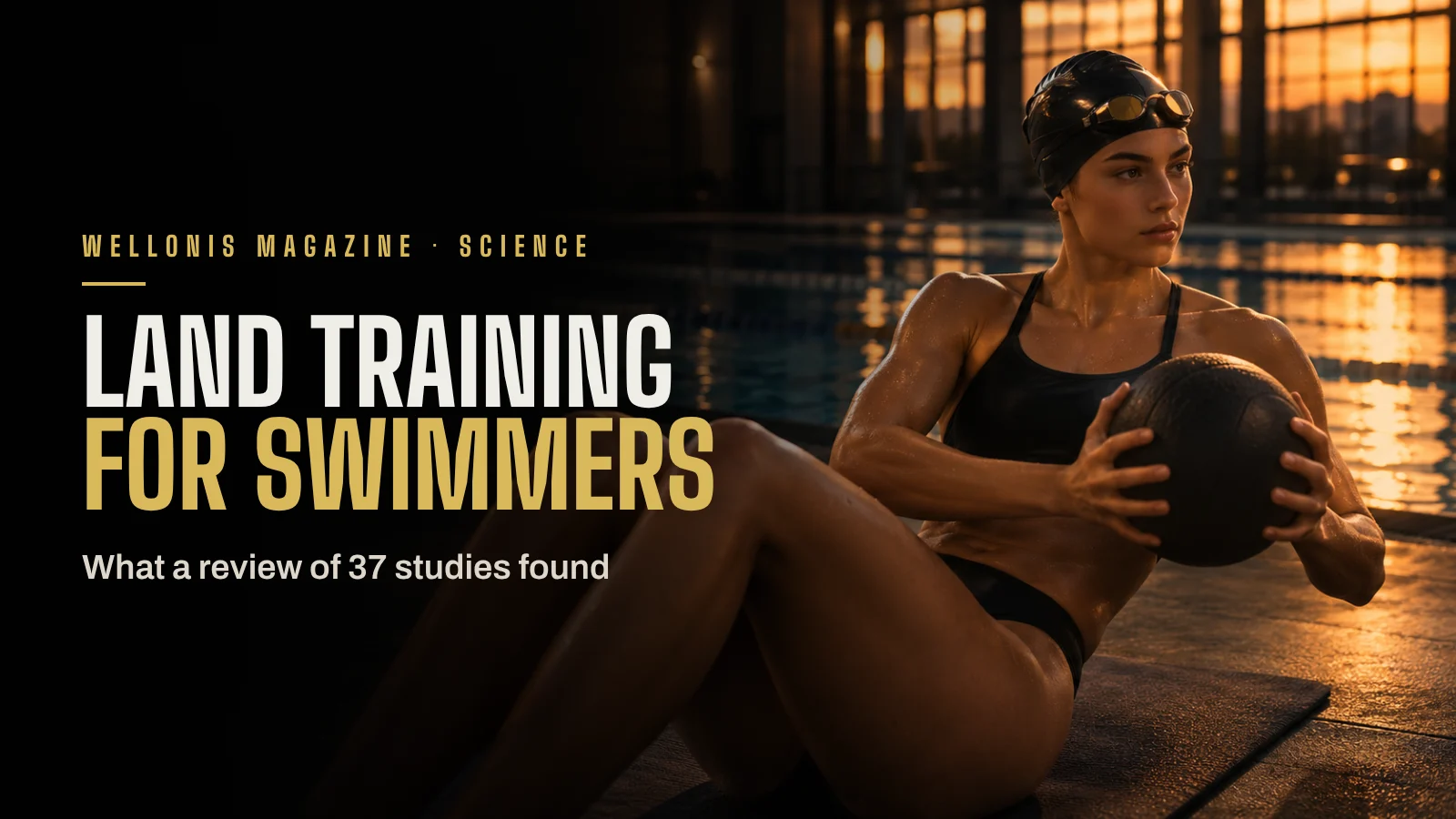
Land training for young swimmers: what one review of 37 studies found
Wellonis Science Desk · 9 Nov 2026 · 4 min read
A new review compares core, plyometric and resistance training for developing competitive swimmers. All three showed positive average effects, but the strength of evidence varied.
Pool time gets most of the attention, but many competitive swimmers also spend part of their week on land, doing core work, jumps or weights. A new review pulled together 37 studies to ask which of these land-based methods helps swimmers most, and whether doing more of them leads to bigger gains.
What the study did
The researchers ran a systematic review and meta-analysis. In plain terms, they searched eight databases up to 15 February 2026, also checked websites and the reference lists of relevant papers, and kept only controlled studies. Each included study looked at one of three dry-land approaches: core training, plyometric training (jumping and fast stretch-and-rebound work), or resistance training. The swimmers were youth, adolescent or age-group athletes who trained to compete and were on a developmental pathway in their sport.
In total, 829 swimmers took part. Fourteen studies covered core training, eight covered plyometrics and fifteen covered resistance training. The team rated study quality with the PEDro scale and calculated Hedges' g, a way of expressing how large a before-to-after change is, so results from different tests could be compared on one scale. They then combined the results statistically and ran extra checks, including models that looked at how the amount of training related to the outcomes.
What it found
All three approaches were linked with positive average changes in both swimming-specific performance and general physical fitness. For swimming performance, the pooled effect sizes were g = 0.204 for core training, g = 0.376 for plyometrics and g = 0.291 for resistance training. For physical fitness, they were g = 0.541 for core, g = 0.247 for plyometrics and g = 0.356 for resistance.
Not every result was equally solid. The review says the statistical support was stronger for core training on swimming performance, and for resistance training on both swimming performance and physical fitness. Core training's effect on physical fitness, and both plyometric outcomes, were more sensitive to how the analysis was done, so they deserve more caution. Differences between studies ranged from none to moderate.
The dose-response part was exploratory. The researchers looked at how different amounts of training related to results, but only within the ranges that had actually been studied. The patterns differed by modality and by outcome. They also checked whether gains in physical fitness went along with gains in swimming performance. For resistance training this link was the clearest. For plyometrics it was positive but depended on conditions. For core training it was not stable.
What it means in the gym
Think of this review as a map rather than a recipe. A few practical points stand out:
- Land training looks like a useful addition for developing swimmers, whichever of the three styles is chosen.
- If the main aim is building general strength and physical capacity, resistance training had the most consistent support here.
- If the aim is swimming-specific gains, plyometrics showed the largest average effect, but its evidence was less stable, so treat it as one tool among several.
- Core training showed smaller average effects on swimming, and its link to physical fitness was inconsistent. It may work best as support for the other work rather than the main focus.
- Match the choice to the goal and to where the swimmer is in their development, and avoid piling on lots of new work at once.
The authors warn against turning their dose patterns into fixed prescriptions, so don't copy numbers from the review into a plan. Working out the right amount for a particular swimmer is a job for a coach who knows that athlete.
The limits of this study
This is one review, and it is only as strong as the studies inside it. Those studies were varied in design, and the groups for each modality were modest in size, with the plyometric group the smallest at eight studies. Quality ratings varied, and several results shifted depending on analysis choices. The dose-response and comparison-level findings are exploratory and describe only the ranges that happened to be tested. They do not show what happens with more or less work, or in swimmers outside the age and pathway groups included.
Most of the included results were before-and-after changes in controlled studies. That tells us the direction and rough size of effects, not what any individual swimmer will achieve. Nothing here is a guarantee. If a young athlete has an injury, pain or a health condition, or is taking medication, talk to your doctor before changing their training.
A coach can help you apply findings like these to a real swimmer's week.
The study
PubMed: PMID 43000402

Comments
No comments yet. Start the conversation.
Log in or create a free account to comment.